


How Should a Bra Fit? Fixes for Bands, Straps and Wires
The band does most of the work: it should sit level and snug on the loosest hook. Here's how to fix a riding band, digging straps and poking wires.

How should a bra fit?
A bra fits when the band sits level and snug on the loosest hook, the straps stay put without digging, the cups lie smooth with no gaps or spillover, and the center sits flat against you.
Most of the support comes from the band, not the straps, so most fit problems trace back to it. That holds for every style of our Catherines everyday bras, wired or wire-free.
- Band: level all the way around and firm on the outermost hook.
- Straps: stay on the shoulder without lifting the band or leaving grooves.
- Cups: smooth edges, no gaping at the top, no spilling over the sides.
- Center: the front piece between the cups rests flat, or nearly flat, on your breastbone.
How to check your bra fit in five steps
Put the bra on the loosest hook, settle in, level the band, set the straps, then move around. Do it in front of a mirror, ideally in a fitted top so you can see the line.
- Fasten the loosest hook. Hook a new bra on the outermost set of eyes. As the elastic relaxes with wear, you move inward to keep the band snug.
- Lean forward and settle in. Bend slightly at the waist, then scoop each side of the bust into its cup so all of you sits inside the wire or cup edge.
- Level the band. Stand up and check the back in a mirror. The band should run straight across, level with the front, not arched toward the shoulder blades.
- Adjust the straps last. Tighten or loosen each strap until it stays put without lifting or digging. You should be able to slide two fingers under it.
- Move before you decide. Raise your arms, sit down and reach forward. A good fit stays put through all three: no riding, no gaps, no poking.
Why does my bra band ride up?
A band that rides up is too big. When it can't anchor around your ribs, the straps pull the back upward and the front drops, so you lose lift exactly where you want it.
Shoppers describe it plainly: "after an hour the back kept riding up." This means that the incorrect band size was ordered. Here's what to change, in order:
- Move to a tighter hook. If you're already on the tightest one, the elastic has likely relaxed and it's time to replace the bra.
- Go down one band size and up one cup, for example 42C to 40D. That keeps the cup room while firming the band.
- Loosen the straps slightly. Over-tight straps lever the back band upward.
Construction helps, too. Our Cotton Comfort Wireless Bra has a U-shaped back that, per its product page, helps keep straps in place, plus a quadruple hook-and-eye closure for fine-tuning the band. It comes in bands 38–54 and cups A–G. If you prefer no wire at all, browse more wire-free styles and run the same band check on each.
What should I change when bra straps dig in?
Straps that dig usually mean the band isn't doing its share, so the shoulders carry the weight. Fix the band first, then loosen the straps until they rest without grooves.
If the band is right and the straps still press, look at the strap itself. Wider, cushioned straps spread the load over more of the shoulder:
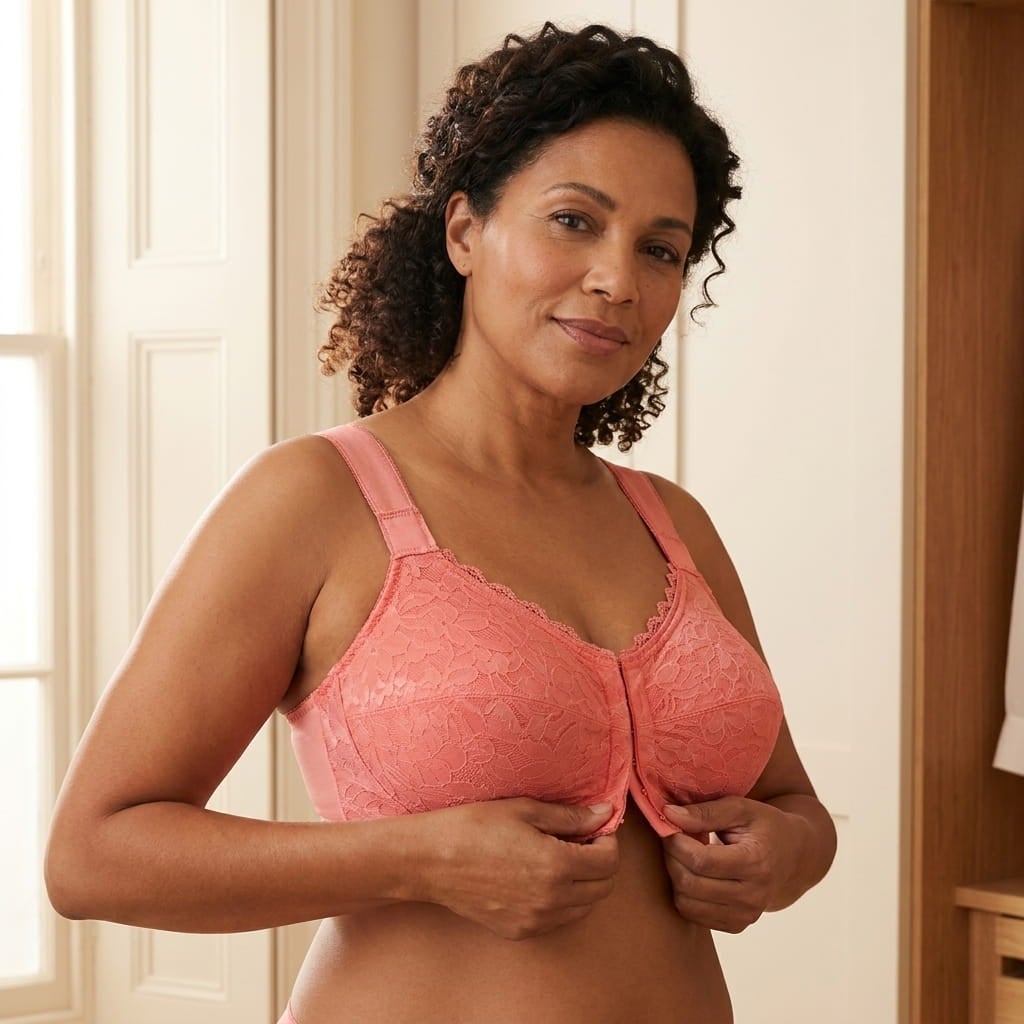
- Our best-selling FrontClose Wireless Posture Bra has wider comfort straps designed to help prevent shoulder dig-in, cushioned front-adjusting straps and an easy front closure. Bands 38–54, cups B–G.
- The Glamorise Magic Lift Support Wireless Bra pairs extra-wide, cushioned straps with a foam-cushioned band that crosses over and under the bust for lift. Bands 36–56, cups B–J.
- The Playtex 18 Hour Ultimate Shoulder Comfort Wireless Support Bra uses wider cushioned straps that adjust easily and stay in place. Bands 36–54, cups B–H.
Many posture bras also add a crisscross or reinforced back, which keeps straps closer to the neck so they're less likely to slide or bite. Treat these as comfort features, not a cure-all; the band still has to fit.
Why does my underwire poke?
A poking wire usually means the cup is too small, so the wire sits on breast tissue instead of behind it. Less often, the wire is unseated or worn through after many washes.
- Pokes at the center or under the arm: go up one cup size on the same band and re-check.
- Pokes only after a while: lean forward and resettle; a band that rides up drags the wire out of place.
- Wire breaking through the fabric: retire the bra. No adjustment fixes a broken channel.
If you like the shape a wire gives, the Glamorise FrontClose Underwire Bra uses padded underwire for extra cushioning, along with wide cushioned straps and a front closure. It runs in bands 36–50 and cups B–DD and F–H. Compare other Catherines underwire bras by cup range before you choose, since wire width follows the cup.
Bra fit problems: a quick fix chart
Match what you see in the mirror to its most likely cause, then make one change at a time and re-check.
| What You Notice | Usual Cause | What To Try |
|---|---|---|
| Band rides up the back | Band too loose or stretched out | Move to a tighter hook; try one band size down and one cup up |
| Straps dig into shoulders | Band not carrying the weight | Fit the band first, then loosen straps; look for wider, cushioned straps |
| Straps slip off | Straps set wide or too loose | Shorten straps; try a U-shaped or crisscross back |
| Underwire pokes at the center or sides | Cup too small or wire not seated | Scoop and settle; try one cup size up on the same band |
| Cups gap at the top | Cup too large or wrong shape | Try one cup size down or a fuller-coverage cup |
| Spillover at the top or sides | Cup too small | Go up one cup size and re-check the wire placement |
Frequently asked questions
How tight should a bra band be?
Snug enough that you can slide about two fingers under the back band, and no more. It should feel secure on the loosest hook when new, without leaving deep marks.
Is a bra true to size from one style to the next?
Not always. Stretch, cup shape and band height vary by style and maker, so re-run the five-step check whenever you try a new bra, even in your usual size.
What is a sister size?
A size with the same cup volume on a different band. Going down one band and up one cup, such as 40D to 38DD, keeps the cup room while tightening the band.
Should I switch to a wireless bra if wires bother me?
It's worth trying once you've ruled out a too-small cup. Wireless styles rely on a snug band and supportive cups or crossover bands for lift, so the band check matters even more.
When should I re-check my bra size?
Whenever a favorite bra starts riding up on the tightest hook, when your weight shifts, or when straps begin doing more work than they used to.