


How to Measure Your Calf for Wide-Calf Boots
Seated, wrap a soft tape around the widest part of your calf over your layers, then compare it to the calf size on our Wide Calf Boots size chart.

The number that matters is your calf circumference at its widest point, measured seated, over the layers you'll wear. Hold it against the calf circumference listed on the boot and you know before you buy whether it will zip. It is the question shoppers ask most about boots, so here is the full method, plus how to read the listing and what to do when a style doesn't list it.
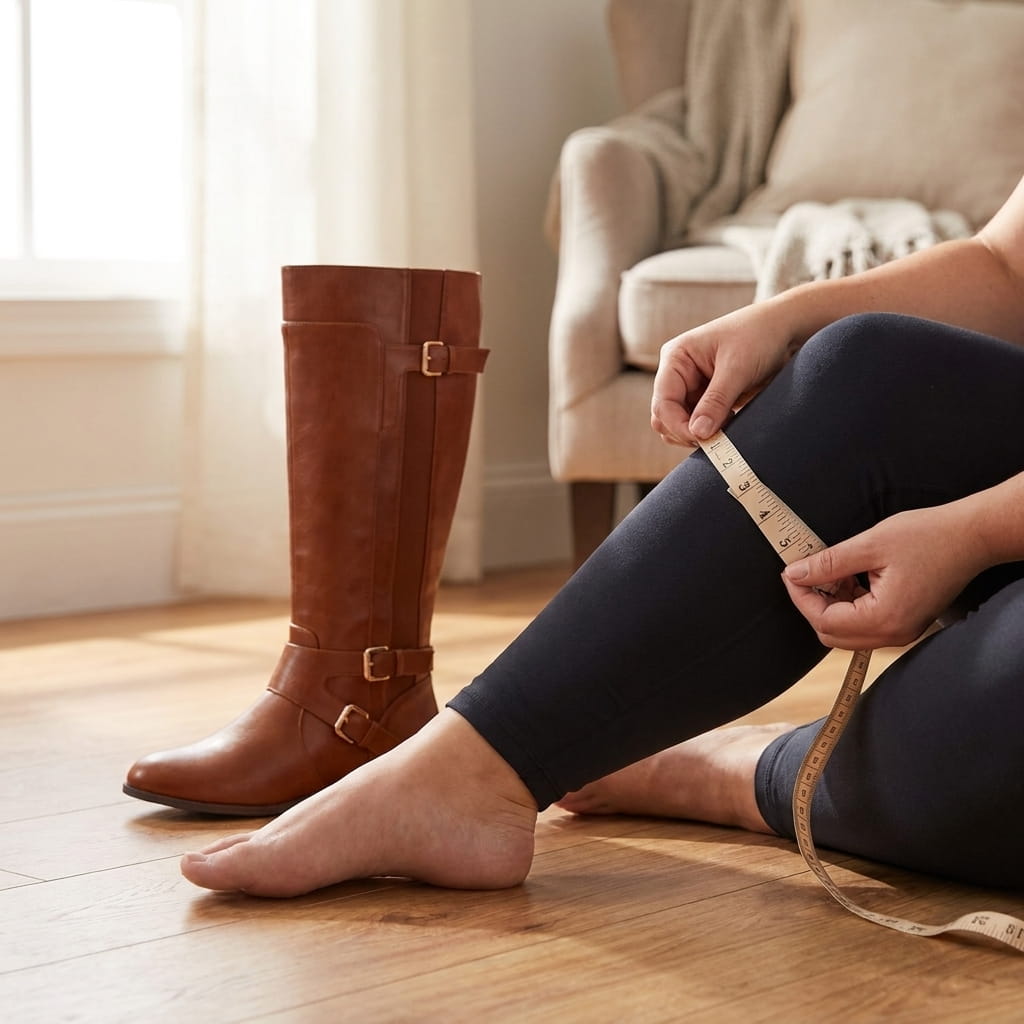
How do you measure your calf for boots?
Sit with your foot flat, wrap a soft tape around the fullest part of your calf over your usual leggings or pants, and note the number. Do both legs and keep the larger one.
- Gather a soft tape and your boot layers. Use a flexible fabric tape measure, not a metal one. Put on the leggings, tights, or pants you plan to wear inside the boots.
- Sit down with your foot flat. Sit on a chair with your knee bent at roughly a right angle and your foot flat on the floor. Your calf relaxes and spreads a little when seated, which is how it sits when you zip boots on.
- Find the widest part of your calf. Slide the tape up and down the back of your leg until you find the fullest point. It's usually a few inches below the back of the knee.
- Wrap the tape level and snug. Keep the tape parallel to the floor, snug against the leg but not pressing in. Read the number where the tape meets.
- Measure both legs. Calves are rarely identical. Write down both numbers and shop by the larger one.
- Measure your leg height. Measure from the floor up the back of your leg to the crease behind your knee. That tells you how tall a boot shaft can be before it bumps the knee.
Keep both numbers, calf circumference and leg height, in your phone. You'll use them every time you shop for tall boots.
Why measure over leggings, tights, or jeans?
Whatever you wear inside the boot takes up room in the shaft, so a bare-leg measurement can leave a boot too tight once you're dressed. Measuring over your real layers builds that room in automatically.
- Sheer tights or thin leggings add very little. One measurement over them usually covers most outfits.
- Jeans or thicker pants tucked in add noticeable bulk. Measure over the actual pair if you plan to wear boots with them often.
- Cozy socks or boot liners matter for winter boots, especially around the ankle and lower calf.
If you wear boots several ways, measure over your bulkiest layer. A boot with a little extra room still looks polished over leggings; one that won't zip over jeans stays in the closet.
How do you compare your measurement to a boot's listing?
Look for the calf circumference on the boot's product page Size Chart and compare it to your larger calf number. If the boot's figure equals or comfortably exceeds yours, it should zip; if it's smaller, keep looking.
When you browse Catherines wide calf boots, check each style's details for these numbers:
Treat the listed number as a guide, and if your measurement lands right at the edge, lean toward a style with a little more room.
| Detail | What It Tells You | Compare It To |
|---|---|---|
| Calf circumference | How much room the shaft has around your leg | Your larger calf measurement, taken over your layers |
| Shaft height | How far up your leg the boot reaches | Your floor-to-knee-crease measurement |
| Closure | Whether a zipper, stretch panel, or pull-on design gets it over your calf | How easily you want to get boots on and off |
| Width (M, W, WW) | Room across the foot, separate from the calf | Your usual shoe width |
What if a boot doesn't list its calf circumference?
Ask before you buy. Post the question in the product's Q&A, or contact customer service, and give your calf measurement so the answer is specific to you. Our Wide Width Boots size chart does list our regular vs. wide calf circumference equivalent measurements for each boot size!
"What is the circumference?" and "What is calf width on these?" are among the most common boot questions shoppers ask, so you're in good company. While you wait, look for clues in the product name and description: "wide calf" or "extra wide calf" in the name, a full-length zipper, or a stretch gore all signal more room in the shaft.

How tall should a boot shaft be?
A knee-high shaft should end just below the crease behind your knee, so it doesn't rub when you sit or bend. Compare the listed shaft height to your floor-to-knee measurement.
- Shaft shorter than your leg height: it will sit below the knee as designed. A little clearance below the knee crease keeps it comfortable when you sit.
- Shaft equal to or taller than your leg height: it may dig in behind the knee when you sit. This is a common complaint with tall boots, so check this number closely.
- Mid-calf styles: the shaft ends at or below the fullest part of your calf, so check that the top opening clears it comfortably.
Heel height also changes where the shaft lands, so check whether a boot's listed height includes the heel.
What is the difference between wide calf and extra wide calf?
Both add room in the shaft around your leg; extra wide calf adds more. There's no single industry standard for either, so the boot's listed calf circumference in our Size Chart is the number to always trust.
Fit is personal, which is why we always come back to your own measurement. As one shopper put it, her wide-calf boots "fit my calves great and support my ankles which I had a hard time finding."
| Term | Where The Extra Room Is | Who It Helps |
|---|---|---|
| Regular calf | Standard shaft width | Calves that fit comfortably in most tall boots |
| Wide calf | A roomier shaft | Calves that feel snug or won't zip in regular-calf boots |
| Extra wide calf | An even roomier shaft | Fuller calves, or anyone wearing thicker layers inside |
| Wide width (W, WW) | Across the foot, not the leg | Wider feet, regardless of calf size |
How do you know if you need wide-calf boots?
If regular boots won't zip, the zipper strains, or the shaft leaves marks on your leg, a wide-calf style is the better fit. Your measurement compared with a boot's listed circumference confirms it.
- The zipper stops partway up, or you have to hold your breath to close it.
- The boot zips but feels "a little tight on my big calves," as one reviewer described it.
- You can't tuck jeans or pants in without the shaft pinching.
- The top edge leaves a red line or indent after a few hours.
If your calves fit standard shafts comfortably, regular calf boots will give a closer, sleeker line without excess room to slouch.
Which boot styles make calf fit easier?
Ankle boots skip the calf question entirely, and boots with zippers, stretch panels, or adjustable details give you more flexibility than pull-on tall shafts.
- Ankle boots and booties: if tall shafts have never worked for you, ankle boots and booties give you a boot look with no calf measurement to worry about.
- Cold-weather styles: when you shop Catherines winter boots, measure over the thick socks and pants you'll wear outside, since that's where the extra bulk shows up.
- Full-length zippers: they make it easier to get a snug shaft on and off, and help you judge fit as you close them.
- Stretch panels or gores: they add a little give where your calf is fullest.
Fixing common tall-boot fit problems
Most fit problems trace back to one of two numbers: calf circumference or shaft height. Here's what each symptom usually means.
- Too tight at the calf: re-measure over your actual layers and look for a larger listed circumference, or try an extra wide calf style.
- Gapes or slouches: the shaft is much wider than your calf. A regular-calf or less roomy style may sit closer.
- Rubs behind the knee: the shaft is too tall for your leg. Compare the listed height to your floor-to-knee measurement.
- Tight across the foot but fine at the calf: that's a width issue, not a calf issue. Look for W or WW sizing.
Two numbers, measured once, take the guesswork out of every boot you shop from here on. That's how boots should fit you beautifully.
Frequently asked questions
Should I measure my calves in the morning or evening?
Measure later in the day if you can. Legs often feel fuller after hours on your feet, and a boot that fits then will feel comfortable all day.
Can I measure my calf without a soft tape measure?
Yes. Wrap a piece of string or a phone charger cord around the widest part of your calf, mark where it meets, then lay it flat against a ruler.
Do boots stretch at the calf over time?
Some materials give a little with wear, but don't count on it. Buy for the measurement you have today, so the boot zips comfortably from the first wear.
What if my calves are two different sizes?
Shop by the larger measurement. A little extra room on one leg is far more comfortable than a zipper that strains on the other.
Is a wide-width boot the same as a wide-calf boot?
No. Wide width (W or WW) adds room across the foot. Wide calf adds room in the shaft around your leg. Some boots offer one, some both, so check each product page and both of the Size Charts to be certain.