


Shoe Widths Explained: M vs. W vs. WW
M is medium, W is wide or one width wider and WW is wider still, extra wide. Wide width is about your foot; wide calf is about a boots' shaft.

What do M, W and WW mean in shoe sizes?
The letters after your shoe size describe width, not length. M is medium, W is wide and WW (wide wide) is extra wide. A 9 W and a 9 WW are the same length; the WW simply gives you more room across the foot.
- M (Medium)
- The standard width most shoes are built on.
- W (Wide)
- One width wider than medium, with more room through the ball of the foot and the toe box.
- WW (Wide Wide)
- Wider than W, for feet that still feel snug in a wide shoe.
Many of the wide-width shoes at Catherines are offered in all three. The Vida Leather-Like Slip On Pump, a Comfortview style, comes in full and half sizes 7–11 and size 12 in M, W and WW, so you choose your length and your width separately.
Is E wide the same as W?
Often, but not always. Some brands label width with letters instead of M, W and WW. In women's shoes, B commonly means medium, C or D commonly means wide, and E or more usually signals extra wide, but each brand sets its own scale.
That's why an E from one maker can feel roomy while another feels close to a standard wide. Treat letter widths as a starting point, and when a listing uses M, W and WW, shop by that scale instead of converting.
How do I know if I need wide or extra wide shoes?
You likely need W if medium shoes pinch across the ball of your foot or crowd your toes even when the length is right. Try WW if wide styles still feel snug in the same spots.
Signs medium is too narrow
- Your toes feel pressed together or the toe box feels tight.
- Your foot presses against or over the edges of the sole.
- You notice red marks or pressure along the outer edge of your foot.
- The heel fits, but the widest part of your foot feels squeezed.
Signs to try WW instead of W
- Wide shoes still feel tight across the toes after a few hours.
- Slip-on styles feel snug over the top of your foot as well as across it.
- You've been sizing up in length just to get enough room.
A quick at-home width check
- Later in the day, stand on a sheet of paper with your weight on one foot.
- Trace around your foot, keeping the pen upright.
- Pull the insole from a shoe in your usual size, or trace the sole, and set it on top of your tracing.
- If your tracing spreads past the edges at the ball of the foot, go one width wider.
Wide width vs. wide calf: what's the difference?
Wide width is about your foot: extra room across the ball and toes. Wide calf is about a boots' shaft: extra room around your lower leg. They're separate measurements, so you might need one, both or neither.
Need a wide foot but not a wide calf? Shop by shaft fit first, then check widths. Catherines groups boots as wide calf boots and regular calf boots, so you can pick the shaft that suits your leg and then see which widths each style is offered in.
| Question | Wide Width (W, WW) | Wide Calf |
|---|---|---|
| What it describes | Room across the foot | Room around the boot shaft |
| Where you feel it | Ball of the foot and toe box | Calf and lower leg |
| Which shoes it applies to | Any style: flats, pumps, sneakers, sandals, boots | Boots with a shaft |
| Where it's shown | The width letter next to your size | The boot's calf or shaft fit |
| Sign it's wrong | Pinched toes, pressure on the sides | Shaft won't zip or digs into your leg |
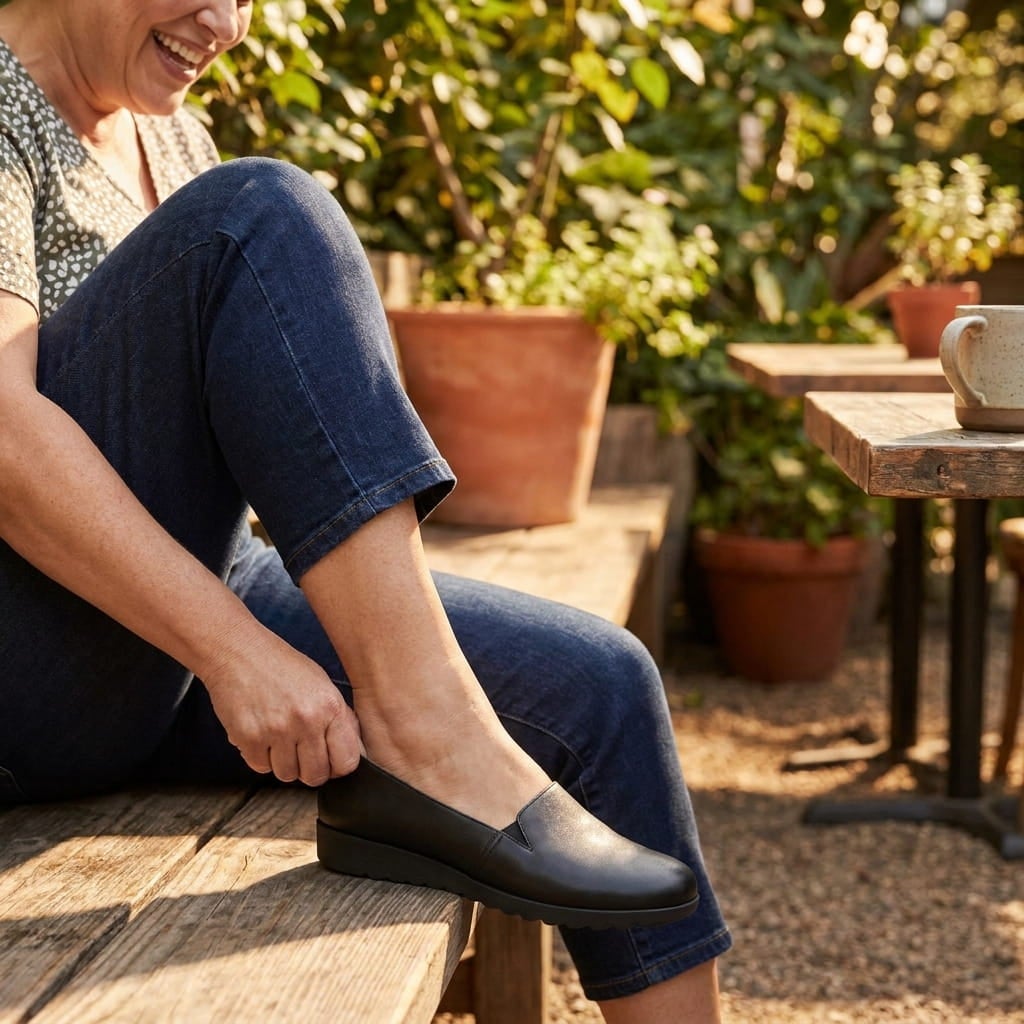
How shoe style changes the way width feels
The same width can feel different from style to style. Open designs, elastic and adjustable straps offer some give, while closed-toe pumps and flats need the width right from the start.
Closed-toe pumps
A closed toe box leaves no room to spare, so width matters most here. The Vida pump pairs a 1½-inch stable block heel with a padded insole and a flexible, skid-resistant outsole. If you're unsure between W and WW, the toe box is where you'll feel the difference. See more wide-width dress shoes for work and occasions.
Slip-on flats
Slip-ons rely on width and the top of the foot to stay on. The June Leather-Like Slip On Flat has elastic gore for a little give as you step in, a padded insole and a skid-resistant ridged outsole. Elastic helps with comfort, but it doesn't replace the right width letter. Browse more Catherines comfortable wide width flats.
Slingbacks and open styles
Open designs are more forgiving at the toes and sides. The Rider slingback has a peep toe and an adjustable buckle with elastic for a secure heel, and comes in M, W and WW in full and half sizes 7–11, plus 12 and 13.
Tips for ordering the right width online
Get the length right first, then choose the width. These habits help you land on the right fit the first time.
- Don't size up for room. A longer shoe adds length, not the width you need, and can slip at the heel.
- Check fit later in the day. Feet tend to be fuller by evening, so that's when a snug shoe shows itself.
- Think about what you'll wear with them. Bare feet, hosiery and socks each change how a width feels.
- Match the width to the style. Be exact in closed-toe pumps and flats; open and adjustable styles leave a little leeway.
- Look for comfort details. Comfortview, a shoe brand sold at Catherines, builds its shoes with padded insoles and flexible outsoles; the Comfortview shoe guide covers its styles in more depth.
Once you know your width, shop wide-width shoes in M, W and WW and filter by the fit that's yours.
Frequently asked questions
Should I go up a size instead of buying wide shoes?
Usually not. Going up a size adds length, so the shoe can slip at the heel while still feeling snug across the ball of your foot. Keep the length that fits and choose W or WW instead.
Are wide-width shoes only for larger shoe sizes?
No. Width and length are separate, so a size 7 can need WW and a size 12 can need M. The June Flat, for example, comes in M, W and WW across full and half sizes 7–11 and size 12.
Can a shoe be too wide?
Yes. If your heel lifts as you walk, your foot slides forward or the sides gap open, try one width narrower. The right width feels secure at the heel with easy room across the toes.
Do wide calf boots also come in wide widths?
Some do and some don't, because shaft fit and foot width are set separately. Check each boot listing for both its calf fit and the widths it's offered in before you order.